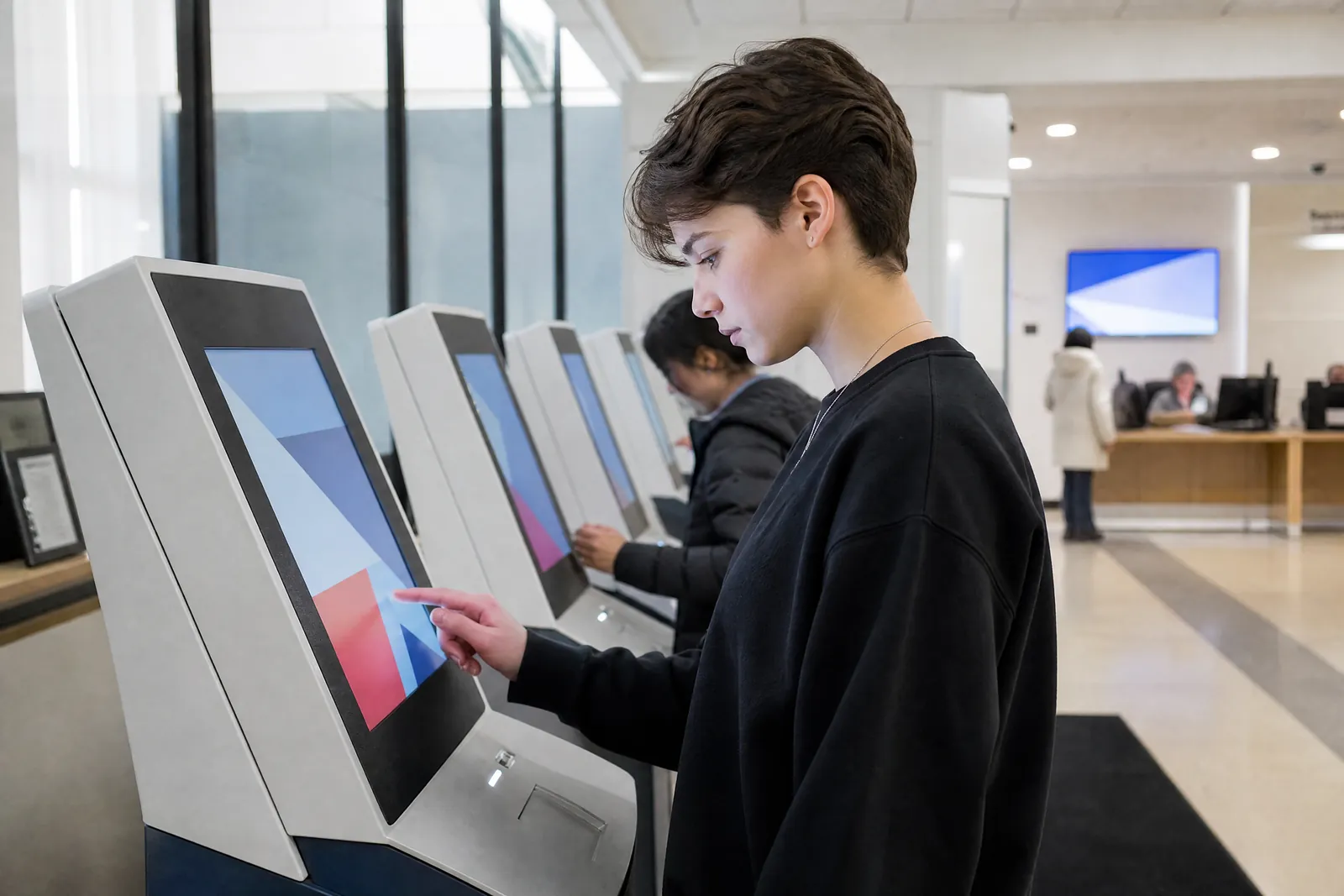
Vision test
- The DMV gives every applicant a vision test to make sure their eyesight is good enough for safe driving.
- If you wear glasses or contact lenses while taking the vision test, your license will carry a corrective lenses restriction.
- Anyone who does not pass the vision screening will be asked to get a Report of Vision Examination (DL 62) form completed by their eye doctor.
Knowledge test
- You get three tries to pass the knowledge test; after that, you must reapply.
- A minor who fails the knowledge test must wait seven days before retaking it, and the day of the failure does not count toward those seven days.
- For a license renewal, eLearning may be offered instead of a regular test; it is a self-paced interactive course in modules, with a quiz after each module, and you cannot fail it.
- Your testing options become available after you finish your license application.
- To get an original driver's license, you must pass a multiple-choice knowledge test.
- The eLearning course can be completed on a computer, laptop, tablet, or mobile device.
- Testing aids, such as a California Driver's Handbook or a cell phone, may not be used during a knowledge test.
Behind-the-wheel test
- Applicants for an original driver's license must take a test showing they can drive a vehicle safely.
- When renewing, drivers who have a vision or medical condition may have to take a behind-the-wheel test.
- The examiner may give you two or more directions at once to see if you can understand and correctly carry out both, such as turning left at the next street and then left again at the first intersection.
- A minor who fails the behind-the-wheel test must wait 14 days before retaking it, not counting the day of the failure.
Drive test requirements
- You must bring valid proof of insurance and the vehicle's registration to the drive test.
- You must bring a vehicle that is safe to drive for the test.
- If you use a rental vehicle for the drive test, your name must appear on the rental contract, and the contract must not exclude behind-the-wheel drive tests.
- When you show up for the behind-the-wheel test, bring along your driver's license or instruction permit if you hold either one.
Pre-drive vehicle check
- Before the drive test begins, the examiner will ask you to find and demonstrate several vehicle parts and controls.
- The window on the driver's side must be able to open.
- The windshield must give both you and the examiner a full, clear view with nothing blocking it; cracks in the windshield may cause your test to be postponed.
- The vehicle needs at least two rearview mirrors, and one must be on its left side.
- Both the left and right brake lights must work.
- Tires must have tread depth of at least 1/32 inch that is even across the tire.
- A donut (spare) tire may not be used during the drive test.
- The horn must be made for the vehicle, work properly, and be loud enough to hear from at least 200 feet away.
- You must show the examiner how to set and release the emergency (parking) brake.
- You must demonstrate the turn or arm signals for a left turn, a right turn, and slowing down or stopping.
- You may need to show that the windshield wipers work by using their control arm or switch.
- Every seat belt must work correctly, and everyone in the vehicle must wear one.
- If your vehicle fails to meet these requirements, your drive test will be rescheduled.
- When the foot brake is pressed down, there must be at least one inch of space between the bottom of the pedal and the floorboard.
Drive test rules
- An interpreter may help during the pre-drive inspection with identifying and using vehicle controls, but may not ride along during the drive test.
- Recording devices, including video and audio recorders, are not allowed during the behind-the-wheel test.
- If a recording device cannot be turned off or disabled, you must cover or block it so it records no video or audio during the test.
- Only the examiner may be in the vehicle with you during the drive test, except in cases of training, service animals, and certain law enforcement situations.
Vehicle technology on test
- The drive test judges your own driving skills in most road situations, not the technology in your vehicle.
- Advanced driver assistance features, such as automated parallel parking, lane departure systems, and adaptive cruise control, may not be used during the drive test.
- Safety features like backup cameras and blind spot monitors may be used during the test, but you must still physically check your mirrors and blind spots.
Drive test scoring
- The drive test is scored on a Driving Performance Evaluation (DPE) Score Sheet, and there is also a Supplemental/Area DPE Score Sheet.
Restated from the California Driver's Handbook, Section 3. Read the official text.
Check yourself on this section
- What is the minimum tire tread depth required for a drive test vehicle?
- Who may normally be in the vehicle with you during the drive test?
- How many rearview mirrors must the vehicle have for the drive test?
- What happens if your vehicle does not meet the pre-drive inspection requirements?
- Which documents must you bring for the vehicle you use on the drive test?
- Which hand or turn signals must you demonstrate during the pre-drive check?
- A minor fails the behind-the-wheel test. How long must they wait before retaking it?
- Which vehicle feature may NOT be used during the drive test?
- For the drive test, the vehicle's horn must be loud enough to be heard from at least how far away?
- What is required to use a rental vehicle for the drive test?
- A minor fails the knowledge test. How long must they wait before retaking it?
- Your vehicle has a dash camera that cannot be turned off. What must you do during the drive test?