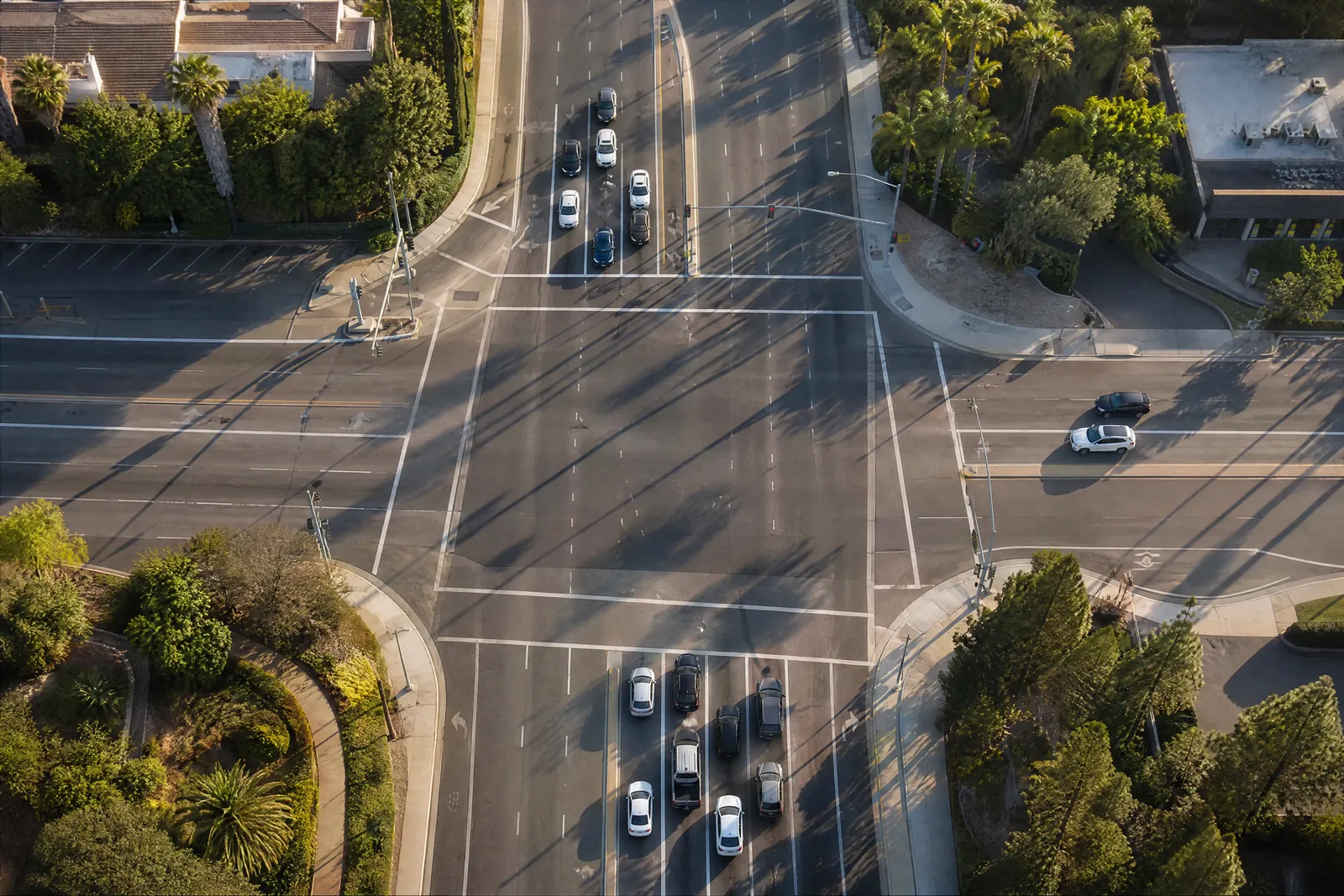
Traffic lanes
- A traffic lane is the part of a road meant for one line of vehicles.
Yellow lines
- A single solid yellow line marks the middle of a road that carries traffic in both directions.
- If your direction has only one lane and there is a solid yellow line on your side, you may not pass the vehicle ahead of you.
- You must not cross double solid yellow lines. Keep to their right, except in the specific cases the handbook allows.
- You may cross double solid yellow lines to use an HOV carpool lane whose designated entrance is on the left.
- You may cross double solid yellow lines when construction or other signs direct you to the other side because your side is closed or blocked.
- Two sets of double solid yellow lines that are two or more feet apart count as a barrier.
- When a broken yellow line is next to your lane, you are allowed to pass, but only if it is safe.
- Do not drive on or across a double-double yellow barrier, and do not make a left turn or U-turn across it, except at designated openings.
- Crossing one set of double yellow lines with a left turn is allowed when you are pulling into or out of a driveway or private road, or when making a U-turn.
White lines
- A single solid white line separates lanes of traffic moving in the same direction, including lanes on one-way streets.
- Double solid white lines form a lane barrier between a regular lane and a preferential lane, such as a carpool (HOV) lane.
- Double solid white lines may also appear in or near freeway on-ramps and off-ramps.
- You must never change lanes across double solid white lines. Wait until the marking becomes a single broken white line.
- Broken white lines divide lanes on roads that have two or more lanes going the same way.
End of lane markings
- Freeway and street lanes that are ending are usually marked with large broken lines.
- If your lane is marked with large broken lines, be ready to leave the freeway or for your lane to end, and watch for a sign telling you to exit or merge.
Yield line
- A yield line is a row of solid white triangles that shows approaching drivers where they must yield or stop.
- The triangles of a yield line point toward the vehicles that are approaching.
Choosing a lane
- Use the left lane when passing or turning left.
- Lanes are numbered starting from the left. The left (fast) lane is the Number 1 Lane, the next lane to its right is the Number 2 Lane, then the Number 3 Lane, and so on.
- The right lane is the one to use for joining or leaving traffic, and also when you move onto the road from a curb or shoulder.
Changing lanes
- Before changing lanes, turn on your signal, check your mirrors, and check the traffic behind and next to you.
- Before changing lanes, look over your shoulder toward the lane you want to enter to be sure it is clear.
- Make sure the next lane has enough room for your vehicle. You do not need to slow down before changing lanes.
- Stay in one lane as much as you can and do not weave through traffic. Changing lanes or direction at the last minute can raise the risk of a crash.
- Once you begin going through an intersection, keep going. Once you start a turn, finish it.
- If you miss your turn, keep driving until you can turn around safely and legally.
- Before changing lanes, check your blind spots for other vehicles, motorcyclists, and bicyclists, and do not let your vehicle drift into another lane.
Passing lanes
- On a road with multiple lanes, the passing lane is the far left lane, nearest the center divider, and it is used for passing other vehicles.
HOV lanes
- Road signs show the hours during which HOV lane rules are in effect.
- Low-emission and zero-emission vehicles may use HOV lanes only if they display a special decal issued by the DMV.
- Motorcycles may use HOV lanes unless signs say otherwise.
- Do not cross double solid lines to get into or out of an HOV lane. Use the designated entrances and exits.
- An HOV lane is reserved for carpools, buses, motorcycles, or low-emission vehicles displaying decals.
- You may use an HOV lane if your vehicle carries the minimum number of people shown on signs at the on-ramp or along the road.
- HOV lanes are marked on the pavement with a diamond symbol and the words Carpool Lane.
Center left turn lanes
- You may drive no more than 200 feet in a center left turn lane.
- A center left turn lane sits in the middle of a two-way street and has two painted lines on each side: a broken inner line and a solid outer line.
- To turn left from a center left turn lane, watch for oncoming vehicles in that lane, signal, and look over your shoulder to check blind spots.
- The center left turn lane exists only so drivers can prepare for and complete left turns or U-turns; you may not use it for ordinary driving or for passing.
- Pull all the way into the center left turn lane so other traffic is not held up, and make your turn once it is safe.
Turnouts
- Some two-lane roads have turnout areas or lanes. Pull into them so vehicles behind you can pass.
- If you are going slowly on a two-lane road where passing would be unsafe and there are five or more vehicles behind you, you are required to pull into a turnout so they can get by.
Bicycle lanes
- Bicycle lanes are only for bicyclists and run next to vehicle traffic. They are usually marked with a single solid white line and signs, and are sometimes painted bright green so they are easier to see.
- On a shared roadway, a car must keep 3 feet of distance between itself and a bicyclist.
- Driving in a bicycle lane is illegal unless you are parking where allowed, entering or leaving the road, or turning within 200 feet of an intersection.
- A bicycle boulevard is a street shared with vehicles where bicycle travel is given priority.
- A separated bikeway, also called a cycle track or protected bike lane, is physically separated from motor vehicles and is only for bicyclists.
- Shared roadway bicycle markings warn drivers that bicyclists may use the full lane and help bicyclists stay in a safe position in traffic.
- Check your blind spots before you move into a bike lane.
- Riders of motorized bicycles should be careful around other bicyclists, ride at a reasonable speed, and not put other bicyclists in danger.
- A standard bike lane runs along a street beside vehicle traffic and is usually marked by a single solid white line that becomes a dashed line near an intersection.
- A buffered bike lane uses chevrons or diagonal markings to give more space between bicyclists and traffic and on-street parking.
- A separated bikeway may be divided from traffic by flexible posts, grade separation, inflexible barriers, or on-street parking.
- A bike route is marked with bike route signs and shared-road pavement markings to indicate a recommended path for cyclists on streets they share with motor vehicles.
Right turns
- To turn right, drive near the right edge of the road, and if there is a designated right turn lane, enter it at its opening.
- Begin signaling about 100 feet before a right turn, then look over your right shoulder and slow down.
- Look left, right, then left again, and turn when it is safe.
- Finish a right turn in the right lane without swinging wide into another lane.
- After coming to a complete stop, you may turn right on a red light unless a No Turn on Red sign is posted.
- You may not turn right while stopped at a red arrow. Wait for the light to turn green.
- When turning right, you may drive in a bike lane within 200 feet of the turn, but check your blind spots for bicyclists.
- When preparing for a right turn, look out for any pedestrians, cyclists, or motorcyclists in the space between your car and the curb.
Bus lanes
- Driving, stopping, parking, or leaving a vehicle in a lane designated for public transit buses is illegal. Signs mark these bus-only lanes.
- You are allowed to cross a bus lane in order to make a right turn.
Dedicated right turn lanes
- If a traffic light or sign is on the right curb of a dedicated right turn lane, you must obey it.
- When turning, always yield to pedestrians in a crosswalk.
- A dedicated right turn lane never merges with another lane, so you can make your right turn without stopping, even if the signal for traffic going straight is red.
Left turns
- Begin signaling 100 feet before a left turn, then look over your left shoulder and slow down.
- Before a left turn, stop behind the limit line, or before the crosswalk if there is no limit line, or before the intersection if there is no crosswalk.
- Look left, right, then left again, start the turn when safe, and move into the intersection so you finish in the left lane.
- Do not turn the steering wheel too early, or you may enter the lane of oncoming traffic.
- Keep your wheels straight until it is safe to turn. If your wheels point left and you are hit from behind, you could be shoved into oncoming traffic.
- Speed up smoothly during and after a left turn, and let the steering wheel straighten out in the new lane.
- You may turn left on a red light only when going from a one-way street onto another one-way street, and only if no sign prohibits it.
- To turn left, drive near the center divider or into the left turn lane, entering a designated left turn lane at its opening without crossing any solid line.
- When turning left on red, yield to vehicles, pedestrians, or bicyclists that have a green light, look both ways, and turn when safe.
U-turns
- A U-turn is allowed across a double yellow line.
- In a residential district, you may make a U-turn if no vehicles are approaching within 200 feet.
- On a divided highway, you may make a U-turn only where an opening in the center divider is provided.
- U-turns are not allowed on a one-way street.
- U-turns are only allowed at an intersection or at a provided opening on a divided highway.
- Never make a U-turn if you cannot see clearly for 200 feet in each direction.
- Never make a U-turn in front of a fire station, and never use a fire station driveway to turn around.
- Making a U-turn means reversing your direction to travel back the way you came; to do it, signal and use either the left turn lane or the lane farthest to the left.
- At an intersection, a U-turn is allowed on a green light or green arrow, as long as no NO U-TURN sign is posted.
- U-turns are never permitted where a NO U-TURN sign is displayed, nor at or on railroad tracks.
Turn examples
- Signs or arrows may show that you can start or finish a turn in more than one lane.
- For a right turn, start and finish in the lane nearest the right edge of the road without swinging wide.
- Bicyclists are legally allowed to use the left turn lane to make left turns.
- At a T intersection where a one-way street meets a two-way street, traffic going straight has the right-of-way, and you may turn right or left from the center lane.
- For a left turn from a two-way street, start in the left lane nearest the middle of the street and end in the left lane nearest the middle of the street going your direction.
- When turning left from a two-way street onto a one-way street, begin from the lane closest to the center (the far-left lane); if three or more lanes go your direction on the new street, you can finish in any lane that is open.
- When turning left from a one-way street onto a two-way street, begin from the far-left lane and finish in the left lane closest to the center of the street heading your way.
- When turning left from one one-way street onto another, begin from the far-left lane; if three or more lanes go your direction, you can finish in any lane that is open.
- When turning right from one one-way street onto another, begin from the far-right lane, and you may finish in any lane if it is safe.
Braking
- To brake, lift your foot off the accelerator, let the vehicle slow, then press the brake lightly until you stop completely, allowing enough space and time.
- Do not go over the limit line when stopping at it.
- When stopping behind another vehicle, leave enough room that you can see its rear wheels.
Merging
- Traffic already on the highway has the right-of-way over merging vehicles.
- When entering a highway, be in the correct lane on the on-ramp and travel at or close to the speed of traffic.
- Merge onto the highway when safe and avoid stopping unless absolutely necessary.
- Merge into a gap big enough for your vehicle to join the lane safely, using your mirrors and turn signals.
- Quickly turn your head to look over your shoulder before merging or changing lanes.
- Keep three seconds of space between you and the vehicle ahead so you can stop safely.
- Do not cross solid lines when merging. To cross several lanes, signal and move over one lane at a time, checking blind spots for vehicles, motorcyclists, bicyclists, and pedestrians each time.
Exiting
- To exit a highway, know where your exit is and watch for it coming up.
- If you need to change lanes before exiting, change one lane at a time, signaling and checking blind spots over your shoulder.
- Once in the correct lane, signal five seconds (about 400 feet) before your exit.
- Be at a safe speed when exiting, and do not cross any solid lines.
Entering traffic
- To merge, enter, or exit traffic on city streets you need a gap of half a block, about 150 feet.
- To merge, enter, or exit traffic on the highway you need a gap of a full block, about 300 feet.
- Even with a green light, do not start into the intersection if pedestrians or vehicles are blocking your way.
- When turning left, do not assume an oncoming car with its right signal on will turn before reaching you; the signal may be a mistake or the driver may turn past you. Wait until it starts turning.
- When pulling into traffic from a full stop, signal and leave enough room to reach the speed of traffic.
Passing
- You must judge whether there is enough room to pass when approaching an oncoming vehicle or bicyclist, or a hill, curve, intersection, or road obstruction.
- Before passing, look ahead for conditions that might make other vehicles move into your lane.
- Do not pass when approaching a hill or curve where you cannot see oncoming traffic. This is especially dangerous on one- and two-lane roads.
- Do not pass at crossroads or driveways, or if you lack enough room to get back into your lane.
- To pass safely, any hill or curve ahead should be at least one-third of a mile away.
- To pass on an open highway: signal, check blind spots over your shoulder, move into the passing lane, speed up to pass, then signal and return to your lane.
- You must never drive off the paved or main-traveled portion of the road in order to pass another vehicle.
Passing on the right
- You may pass on the right only on an open highway with two or more lanes in your direction, when the driver ahead is turning left and it is safe, or on a one-way street.
- Never pass on the left when the driver ahead is signaling a left turn.
Lane markings
- Painted markings on the road show drivers which part of the road to use and help them understand the traffic rules.
Limit lines
- A limit line is a wide white line showing drivers where to stop before an intersection or crosswalk.
- Stop behind the limit line. If there is none, stop before the crosswalk; if there is no crosswalk either, stop before entering the intersection.
Being passed
- If a vehicle is passing you or signals that it wants to, let it pass and keep your lane position and speed steady.
Parallel parking
- Parallel parking means parking your vehicle lined up with the road and with the other parked vehicles.
- When parallel parking, choose a space that is a minimum of three feet longer than your vehicle.
- Once you find a parallel parking space, switch on your turn signal so others know you intend to park.
- To start parallel parking, pull up next to the vehicle in front of the open space, keeping roughly two feet between the two vehicles.
- While setting up to parallel park, stop when your rear bumper lines up with the front of the space, and leave your turn signal on.
- Before backing into a parallel space, check your blind spots by using the rearview mirror and looking over your shoulder for oncoming vehicles and pedestrians.
- When backing into a parallel space, steer so the vehicle enters the space at roughly a 45-degree angle.
- You may have to move forward and back a few times to straighten out in a parallel space.
- A properly parallel-parked vehicle sits parallel to the curb and no more than 18 inches from it.
- After parallel parking, shut off the vehicle and set the parking brake.
- Before getting out of a parked vehicle, check carefully for passing vehicles, bicycles, and motorcycles, and only open the door when it is safe.
- When your rear wheel gets within 18 inches of the curb, start turning the steering wheel away from the curb to straighten out.
Straight line backing
- Before backing in a straight line, watch traffic and check the relevant blind spots.
- Turn on your turn signal before pulling over to the curb, and turn it off once you have finished.
- In straight line backing, reverse straight for three vehicle lengths while staying within three feet of the curb.
- While backing up, keep paying attention to what is behind your vehicle.
- To keep control when backing, reverse at a smooth and safe speed and correct the steering as needed.
- To pull away from the curb after backing, check traffic and blind spots again and signal, repeating the first two steps.
- Before you start backing, check blind spots using the rearview mirror and by looking over your shoulder for approaching vehicles and pedestrians.
Hill parking
- A vehicle parked on a hill might roll if its equipment fails.
- When parking on a hill, set the parking brake and leave an automatic in park, or leave a manual transmission in gear.
- When parked facing downhill, turn the front wheels into the curb, or to the right toward the side of the road.
- When parked facing uphill with a curb, turn the front wheels away from the curb (to the left, toward the center of the road) and let the vehicle roll back a few inches until a wheel lightly touches the curb.
- On a sloping driveway, turn the wheels so the vehicle cannot roll into the street, put it in park, and set the parking brake.
- If you park facing either up or down a slope where there is no curb, point the wheels toward the right, so that if the brakes give out the car moves away from the middle of the roadway.
Colored curbs
- Curbs painted in colors have their own special parking rules.
- At a green curb, you may park for a limited time, which may be shown on a sign or painted on the curb.
- A yellow curb is for loading and unloading passengers and freight, and you must not stop there longer than the posted time.
- Drivers of noncommercial vehicles at a yellow curb usually must remain with their vehicle.
- A red curb means no stopping, standing, or parking.
- Buses are allowed to stop at a red curb zone that is marked for buses only.
- A blue curb is for parking by a disabled person, or by someone driving a disabled person, who has a special placard or special license plate.
- A white-painted curb allows stopping only for the brief time needed to let passengers get in or out.
Illegal parking
- You may never park where a NO PARKING sign is posted.
- You may not park on a crosswalk, whether it is marked or unmarked.
- You may not park in the crosshatched (diagonal lines) area beside a designated disabled parking space.
- You may not park within 20 feet of a marked or unmarked crosswalk.
- Where a crosswalk has a curb extension, you may not park within 15 feet of it.
- You may not park between a safety zone and the curb.
- Double parking is not allowed.
- You may not park on a sidewalk, partly blocking a sidewalk, or in front of a driveway.
- You may not park within three feet of a sidewalk ramp for disabled persons.
- You may not park in front of or on a curb that gives wheelchair users access to a sidewalk.
- You may not park in a space set aside for parking or fueling zero-emission vehicles unless your vehicle is a zero-emission vehicle.
- You may not park in a tunnel or on a bridge unless signs allow it.
- You may not park within 15 feet of a fire hydrant or a fire station driveway.
- Parking against the flow on the opposite side of a street, or parking on a freeway, is prohibited unless there is an emergency, a law enforcement officer orders the stop, or a stop there is expressly permitted.
Electric vehicles
- Local authorities are allowed to reserve parking spaces on public streets for charging electric vehicles.
Driving green
- To get better fuel efficiency and reduce emissions, accelerate and slow down smoothly and keep a steady speed.
- Keeping tires inflated, changing the oil, and checking filters regularly helps fuel efficiency and lowers emissions.
- Removing unneeded weight from your vehicle improves fuel efficiency.
Law enforcement stops
- During a law enforcement stop, move all the way onto the right shoulder, even if you are in the carpool/HOV lane.
- When pulled over, stop in a well-lit area if possible.
- During a law enforcement stop, turn off your radio.
- Stay inside your vehicle during a stop unless the officer tells you to get out.
- After stopping, lower your window before the officer reaches you.
- Before the officer makes contact, the driver and every passenger should keep their hands where they can be clearly seen.
- Officers must tell you why they stopped you before asking questions about a criminal investigation or traffic violation.
- An officer does not have to state the reason for a stop if they reasonably believe keeping it back is needed to protect life or property from an imminent threat.
- The reason for a stop must be written on the traffic citation (traffic ticket) or the law enforcement report.
- When an officer signals you to stop, turn on your right turn signal to show you have seen the officer.
Rights during stops
- You may refuse an officer's request to search your vehicle, but the officer may still have legal authority to search it in certain circumstances.
- If a driver does not provide their license, insurance, and registration, officers may do a limited search to find them.
- An officer may ask passengers for their names or identification; passengers may decline, but in some situations they may be required to identify themselves.
- Even if you think your rights are being violated, do not physically resist or use violence against the officer; you may state your objection verbally instead.
- If an officer asks your permission to do something, you may refuse, but if the officer goes ahead anyway, you have no right to interfere.
- If you do not want your vehicle searched, say clearly that you do not give permission, but do not resist or obstruct the officer if they search anyway.
- A stopped driver must show a driver's license, proof of insurance, and vehicle registration to law enforcement.
- Passengers who do not want to show identification should say so clearly, and they should not interfere with the officer's duties or with an officer who demands identification.
- During a traffic stop, an officer can legally order the driver and all passengers to get out of or stay in the vehicle, and you must obey.
- All people are entitled to safety during a traffic stop, and resisting physically or using violence can put both you and the officer at risk.
- Additional rights also protect you under the U.S. Constitution, the California Constitution, and both state and federal law.
Immigration questions
- In California, only federal law enforcement officers may ask about your immigration status; state and local officers are prohibited from asking drivers or passengers.
- If a California law enforcement officer asks about your immigration status, you can refuse to answer.
Recording officers
- If you are recording a stop, you should make that clear right away.
- Do not interfere with the officer's lawful duties, and do not reach into hidden areas to get a recording device without the officer's permission.
- Generally, you may refuse a request to unlock your cell phone or give its password, but in some situations, such as being on parole, you may have to agree.
- No government employee may retaliate against you simply because you recorded something in public.
- As a general rule, drivers and passengers have First Amendment protection when they record their encounters with police in public places.
- As long as your recording does not get in the way of the officer lawfully doing their job, the officer may not seize the device, erase the footage, or destroy the device simply because you are filming.
Freeway stops
- If you have to stop on a freeway, pull fully off the pavement and stay inside your vehicle with the doors locked until help comes.
Complaints
- A complaint can be filed with the law enforcement agency that employs the officer, and that agency must investigate it.
- Every member of the public can submit a complaint about any law enforcement agency, and the law forbids any government employee from punishing you for doing it.
Restated from the California Driver's Handbook, Section 6. Read the official text.
Check yourself on this section
- What does a single solid white line separate?
- On a shared roadway, how much distance must a car keep between itself and a bicyclist?
- How fast should you be traveling when you enter a highway from the on-ramp?
- When parking facing uphill next to a curb, how should you position your front wheels?
- Where can you file a complaint about an officer's conduct?
- What is the farthest you may drive in a center left turn lane?
- A row of solid white triangles across your lane is a yield line. Which way do the triangles point?
- When turning left from a two-way street, where should you end your turn?
- About how far before a right turn should you begin signaling?
- You need to cross several lanes. What should you do?
- On a highway with several lanes in your direction, which is the Number 1 Lane?
- How large a gap do you need to merge, enter, or exit traffic on the highway?