Vehicle surroundings
- The handbook uses colors to show the zones around a vehicle: green is the area ahead, blue is beside you, yellow marks blind spots, and red is the area behind.
- Knowing what is around your vehicle helps you make good choices and respond to road hazards.
Scanning the road
- Keep your eyes moving and look at least 10 seconds down the road in front of your vehicle.
- Scanning ahead gives you time to react and helps you avoid hazards and sudden last-second maneuvers.
Following distance
- Tailgating means following another vehicle too closely.
- When you tailgate, the vehicle ahead blocks your view of the road, and you will not have time to react if that driver stops suddenly.
- Use the three-second rule to keep a safe following distance and avoid a crash.
- Keeping a safe gap behind other vehicles gives you time to respond if another driver makes an error.
- If a vehicle cuts in too close in front of you, lift your foot off the gas pedal to open up space.
- If someone is tailgating you, leave extra space ahead of your vehicle.
- When being tailgated, keep your speed and path steady, then move into a lane to the right when it is safe so the tailgater can pass.
- Leave extra space ahead when following a motorcycle over gravel or metal surfaces such as bridge gratings or railroad tracks.
Space to the side
- Avoid driving right beside other vehicles so you have room to maneuver and react.
- Make room for vehicles entering a freeway, even when you have the right-of-way.
- Near freeway entrances, be prepared for quick changes and watch other drivers for signals.
- Keep a gap between your vehicle and parked vehicles.
- Look both ways at intersections, even where cross traffic faces a red light or a stop sign.
- Do not stay in another driver's blind spot.
Blind spots
- All vehicles have blind spots, which are areas a driver cannot see while looking forward or using the mirrors.
- On most vehicles, the blind spots are on the sides, a little behind the driver.
- To check a blind spot, look over your left or right shoulder through the side window.
- When checking blind spots, turn only your head; do not turn your body or the steering wheel.
- Check your blind spots before changing lanes, turning at an intersection, merging into traffic, or backing up.
- Check your blind spots before leaving a parking space, parallel parking, pulling away from the curb, or opening your car door.
Checking behind
- Knowing what is behind you helps prevent rear-end crashes.
- Check behind you often using the rearview mirror, the side mirrors, and by turning your head.
- Check traffic behind you when you change lanes, check blind spots, slow down, or turn onto a side road or into a driveway.
- Check traffic behind you when stopping to pull into a parking space, pulling up to or away from the curb, and backing up.
Night driving
- At night, you should be able to stop within the distance your headlights light up.
- Do not use high beams where they are illegal.
- Dim your high beams so you do not blind an oncoming driver.
- Do not keep your high beams on to get back at a driver whose lights are too bright; it makes seeing harder for both of you.
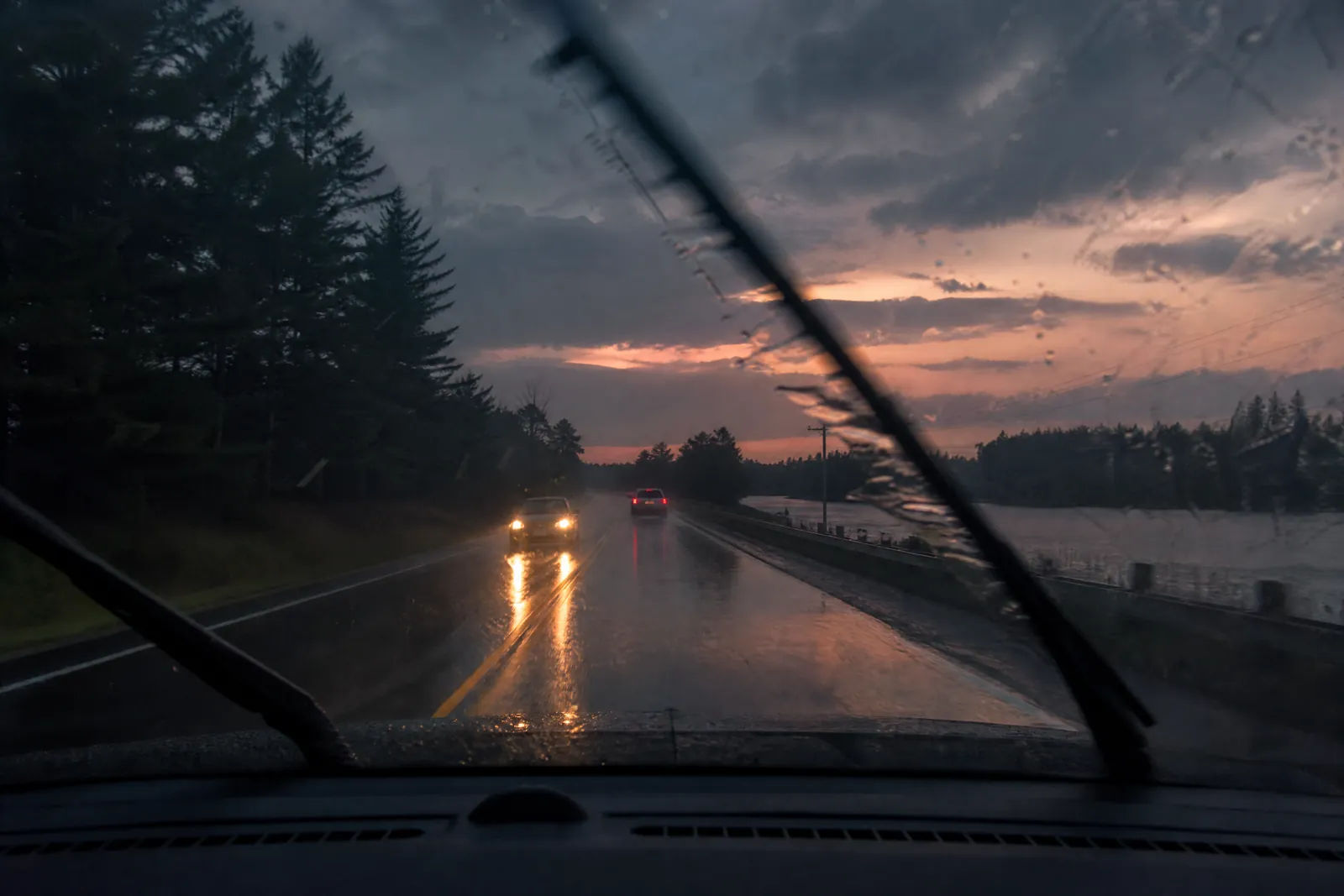
- Use low-beam headlights when it is raining.
- Never drive with only your parking lights on.
- At night, motorcyclists, bicyclists, and pedestrians are much more difficult to see.
- Highway construction may happen at night, so slow down in highway work zones.
- After leaving a brightly lit area, drive slowly until your eyes get used to the dark.
- If a vehicle with only one light is coming toward you, move as far right as you can; it may be a bicycle, a motorcycle, or a car with a headlight out.
- If an oncoming vehicle's lights are too bright, do not stare into them; look toward the right edge of your lane and watch the other vehicle with your side vision.
Sun glare
- Polarized sunglasses help manage sun glare.
- In sun glare, keep enough space between you and nearby vehicles.
- Make sure your sun visor works and nothing blocks it from being used.
- Sun glare can make pedestrians hard to see, so watch for them.
- Try not to drive at sunrise and sunset to avoid glare.
- To reduce sun glare, keep both the inside and outside of your windshield clean.
Skids
- A skid happens when one or more tires lose grip on the road and the vehicle slides, and you may lose control.
Slippery surface skids
- Ice and packed snow can make a vehicle skid, especially when driving too fast or going downhill.
- On ice or packed snow, drive slowly and leave room between you and the vehicle ahead.
- To prevent skids on slippery roads, slow down when approaching intersections and curves; for sharp curves, stay slow both approaching and going through.
- To prevent skids, avoid fast turns and quick stops.
- Shift into a low gear before heading down a steep hill.
- Avoid ice patches, wet leaves, oil, and standing water to prevent skidding.
- If you begin to skid, slowly lift your foot off the gas pedal and do not use the brakes.
- In a skid, steer in the same direction the vehicle is skidding.
- In a skid, try to get one of your wheels onto dry pavement.
Locked wheel skids
- A locked wheel skid usually comes from braking too hard while going too fast.
- In a locked wheel skid, the vehicle keeps skidding no matter how you turn the steering wheel.
- Rear-wheel ABS is common in light trucks.
- With rear-wheel ABS, let up on the brake but keep just enough pressure so the front wheels roll again and you can steer.
- With rear-wheel ABS, then stop braking and steer in the direction of the skid.
- Your vehicle owner's manual tells you whether your vehicle has ABS.
- With four-wheel antilock brakes (ABS), press the brake pedal firmly to get out of a locked wheel skid.
- If your vehicle has front-wheel ABS, lift your foot off the brake pedal so the wheels unlock, point the vehicle in the direction you want, and bring the front wheels back to center as the car straightens out.
Brakes without ABS
- If a vehicle without ABS starts to skid, pump the brakes quickly until you reach a safe speed.
- If the brake pedal sinks to the floor, pump it quickly by gently pressing and releasing it.
- If pumping the brakes does not work, downshift into a lower gear or neutral to slow down, then try the emergency brake to stop.
Slippery roads
- Rain, snow, or mud can make roads slippery, so drive slower than on dry pavement and leave more room ahead.
- On a wet road, lower your speed by 5 to 10 mph.
- On packed snow, cut your speed in half.
- On ice, slow down to 5 mph or less.
- Some road surfaces get extra slippery when wet, and these usually have warning signs.
- Pavement can be very slippery when rain first begins.
- On cold, wet days, shade from trees or buildings can hide icy spots; shaded areas freeze first and dry last.
- Bridges and overpasses often ice over sooner than other parts of the road, so icy patches may be present there.
- Reduce your speed as soon as rain, drizzle, or snow first appears on the road, particularly if the weather has been hot and dry for a while, since oil and dust have not yet been rinsed off the pavement.
Hydroplaning
- While hydroplaning, a small steering change, braking, or a wind gust can send the vehicle into a skid.
- To avoid hydroplaning, drive slowly and steer around standing water when possible.
- Slow down if your tires make sloshing sounds, and slow down when changing lanes or direction on wet roads.
- Hydroplaning happens in wet conditions when the tires lose all contact with the road and the vehicle rides on water.
- If your vehicle starts to hydroplane, slow down gradually and do not brake, since sudden braking can make you lose control.
Stuck in snow or mud
- When stuck, press the gas gently and avoid spinning the wheels.
- When stuck, drive slowly forward as far as you can, then shift to reverse and back up slowly as far as you can without spinning the wheels.
- Keep rocking forward in low gear and backward in reverse until the vehicle rolls free.
- In deep snow or mud, you can place boards or tree branches under the tires, but only while the vehicle is stopped.
- If stuck in snow or mud, shift into a low gear and keep the front wheels pointed straight.
Flooded roads
- Too much water on a road can cause flooding, which may happen slowly or all at once.
- Dangers of flooded roads include being swept away, floating debris and hidden hazards, the road collapsing, vehicle malfunction, and electrocution from downed power lines.
- You may not be able to tell how deep floodwater is just by looking.
- If you have no choice but to drive through a flooded road, go slowly, and test your brakes once you are through the water.
- Deep floodwater can make a road too hazardous to drive through, so choosing a different route is the best option.
High winds
- High winds are especially hazardous for large vehicles like trucks, campers, and vehicles towing trailers.
- In high winds, slow down to keep better control and have more time to react if a strong gust hits.
- In high winds, grip the steering wheel firmly because gusts are unpredictable and can cause loss of control.
- In high winds, stay alert and watch ahead for debris on the road.
- Do not use cruise control in high winds, so you keep full control of the gas pedal if a gust hits.
- During a windstorm, it may be safer to pull over and wait for it to pass.
Fog or smoke
- It is best not to drive in heavy fog or smoke; consider delaying your trip until it clears.
- Do not use high beams in fog or smoke because the light reflects back and causes glare.
- In fog or smoke, never drive using only parking lights or fog lights.
- In fog or smoke, be able to stop within the distance you can see, and increase your following distance.
- Use your wipers and defroster as needed in fog or smoke.
- In fog or smoke, avoid changing lanes or passing unless it is absolutely necessary.
- In fog or smoke, listen for traffic you cannot see.
- If fog gets too thick to drive safely, consider pulling off the road, turning on your emergency flashers, and waiting for better conditions.
- When you have no choice but to drive in thick fog or smoke, go slowly and keep your low-beam headlights on.
Traffic breaks
- In a law enforcement traffic break, an officer turns on emergency lights and slowly weaves back and forth across the lanes.
- During a traffic break, turn on your emergency flashers to warn drivers behind you.
- During a traffic break, gradually slow to match the officer's speed and avoid sudden braking unless needed to prevent a crash.
- During a traffic break, keep a safe distance behind the patrol vehicle and do not pass it.
- Officers use traffic breaks to slow or stop traffic to clear road hazards, during heavy fog or unusual traffic conditions, and to prevent crashes.
- After a traffic break, do not speed up until the officer turns off the emergency lights and traffic allows a return to normal speed.
Wet brakes
- To dry wet brakes, lightly press the gas and brake pedals at the same time, only until the brakes are dry.
Rain and snow visibility
- In rain or snow, turn on your windshield wipers, low-beam headlights, and defroster.
- In a heavy rainstorm or snowstorm, you may be unable to see more than 100 feet ahead.
- If you cannot see farther than 100 feet, driving faster than 30 mph is not safe.
- You may need to stop now and then to clean mud or snow off your windshield, headlights, and taillights.
Snow chains
- If you drive in snowy areas, carry snow chains, which give your tires more traction.
- Carry the right number and type of chains for your vehicle.
Seat belt law
- Both the driver and all passengers are required to wear seat belts, and you can be ticketed for not wearing one.
- The driver can be ticketed if a passenger younger than 16 is not buckled up.
Seat belt benefits
- Using both the lap belt and the shoulder harness improves your odds of surviving most kinds of crashes.
- In a crash the vehicle stops, but your body keeps going at the speed you were driving until something like the dashboard or windshield stops you.
- If your vehicle is hit from the side, the force can throw you back and forth across the seat.
- Seat and shoulder belts help hold you in a position where you can better control the vehicle, and they may reduce serious injuries.
Wearing seat belts correctly
- Wearing a seat belt the right way helps prevent injury or death.
- The shoulder harness should go across your shoulder and chest with little or no slack.
- The lap belt should be snug and sit low across your hips; otherwise you could slide out of it during a crash.
- Never put the shoulder belt under your arm or behind your back.
Seat belts during pregnancy
- A pregnant person should place the shoulder strap between the breasts and off to the side of the belly's bulge.
- A pregnant person should wear the lap belt as low as possible, beneath the abdomen.
Children in front seat
- A child under 8 may ride up front in an approved restraint system if the restraint system cannot be correctly installed in the back seat.
- A child under 8 may ride up front in an approved restraint system if every rear seat is already taken by children 7 years old or younger.
- A child under 8 may ride up front in an approved restraint system if medical reasons keep the child from riding in the back.
- A child under 8 may ride up front in a federally-approved child passenger restraint system if the vehicle has no rear seat.
- A child under 8 may ride up front in an approved restraint system if the rear seats are side-facing jump seats or rear-facing seats.
Child seat installation
- As a child grows, make sure the child passenger restraint system is still the correct size.
- Your local law enforcement agency or fire department can inspect how your child passenger restraint system is installed.
Air bags
- Air bags can make you safer than wearing a seat belt by itself.
- Children sitting next to a side air bag may face a risk of serious or fatal injury.
Air bag distance
- Sit at least 10 inches from the air bag cover, as long as you can still fully control the vehicle.
- If you cannot safely sit 10 inches from the air bag, contact your vehicle dealer or manufacturer for advice on moving back further.
- The 10-inch distance is measured from the center of the steering wheel to your breastbone.
- Passengers should also sit at least 10 inches from the passenger-side air bag.
Unattended children
- Leaving a child 6 years old or younger alone in a vehicle is illegal.
- A child 6 or younger may be left in a vehicle if supervised by someone at least 12 years old.
Hot vehicles
- Leaving children or animals in a hot vehicle is both dangerous and against the law.
- A parked vehicle in the sun can heat up quickly inside, even when a window is cracked open slightly.
- Too much heat exposure can cause dehydration, heat stroke, and death.
Side impact crashes
- If another car strikes your car on the driver's side, you are first thrown toward the driver's door and then bounce back toward the passenger's door.
Child restraint requirements
- Children must be secured in a federally-approved child passenger restraint system or a safety belt, depending on their age and height.
- Children under 8 years old, or shorter than 4 feet 9 inches, must be secured in a child passenger restraint system in a back seat.
- A child aged 8 or above, or one measuring 4 feet 9 inches or taller, is allowed to ride using a correctly secured seat belt that complies with federal standards.
Rear-facing child seats
- Children under 2 years old who weigh less than 40 pounds and are shorter than 3 feet 4 inches must ride in a rear-facing child passenger restraint system.
- A child in a rear-facing restraint system is not allowed to ride in the front seat of a vehicle that has an airbag.
Basic Speed Law
- California's Basic Speed Law says you may never go faster than is safe for the road conditions at the moment.
- Your safe speed depends on conditions, no matter what the posted speed limit is.
- How many vehicles are on the road and how fast they are moving both affect what speed is safe for you.
- Bicyclists or pedestrians who are on the road or crossing it are a reason to adjust your speed.
- Rain, fog, snow, wind, and dust are weather conditions that may require you to slow down.
- The road surface affects safe speed, including whether it is smooth, rough, graveled, wet, dry, wide, or narrow.
Traffic congestion
- Small changes in how you drive can help ease traffic congestion, such as not weaving between lanes on the freeway.
Speed limits
- Unless a different limit is posted, the maximum speed on most California highways is 65 mph.
- Unless otherwise posted, the maximum speed on a two-lane undivided highway is 55 mph.
- Vehicles pulling trailers have a maximum speed of 55 mph unless otherwise posted.
Choosing between hazards
- When there are dangers on both sides of the road, such as parked cars on the right and oncoming traffic on the left, give the most room to the bigger danger.
- If an oncoming vehicle is on your left and a bicyclist is ahead on your right on a two-lane road, do not squeeze between them; deal with one hazard at a time.
- In that situation, slow down and let the oncoming vehicle go by first, then move left to pass the bicyclist.
Passing bicyclists
- When passing a bicyclist, leave plenty of space, at least three feet.
- If oncoming vehicles keep coming steadily, use as much of the left lane as is safe when passing a bicyclist.
Tire blowout
- If a tire blows out, stay calm and do not overreact; braking suddenly or quickly lifting your foot off the gas can make you lose control.
- During a blowout, keep both hands on the steering wheel.
- During a blowout, keep up your speed if it is possible and safe, then slowly ease off the accelerator.
- After a blowout, steer as needed to steady the vehicle, and look and steer where you want to go.
- Once the vehicle is stable after a blowout, keep slowing down and leave the road when and where it is safe.
- The tire blowout steps are recommended by the National Highway Traffic Safety Administration.
Driving off pavement
- If your wheels drift off the pavement, hold the steering wheel firmly and take your foot off the accelerator.
- After drifting off the pavement, brake gently and check for traffic behind you before carefully steering back onto the road.
- Do not jerk the steering wheel hard when returning to the pavement, because you could end up in oncoming traffic.
Overheating
- In very hot weather, keep an eye on the temperature gauge, avoid long stretches of high-speed driving, and turn off the air conditioner.
Cold weather
- In very cold weather, watch the temperature gauge, since the engine might not have enough antifreeze.
- To keep windows from fogging in extreme cold, use the defroster or crack the windows open slightly.
Vehicle care
- The vehicle owner's manual has more information about handling heat and cold conditions.
Freeway breakdown
- If your vehicle breaks down on the freeway, pull over safely onto the right shoulder.
- If you have to leave a disabled vehicle on the freeway, get out on the right side, away from traffic.
- For help after a freeway breakdown, dial 511 on your cell phone or find a call box.
- Get back into your disabled vehicle as soon as possible, entering from the right side away from traffic.
- Generally, stay in your disabled vehicle with your seat belt fastened until help comes.
- Using emergency flashers is up to you; they help other drivers see you at night and in various weather conditions.
Freeway Service Patrol
- The CHP Freeway Service Patrol (FSP) offers free emergency roadside help in certain areas during commute hours.
- FSP will refill your radiator, tape hoses, change a flat tire, and report a collision to CHP.
- If FSP cannot get your vehicle running, they will tow it for free to a CHP-approved location, and CHP will contact an auto club or towing service.
- FSP does not tow motorcycles.
- FSP does not help vehicles involved in a collision unless CHP tells them to.
- Call 511 for information about and assistance from FSP.
- FSP will give you a gallon of gas if you run out and jump-start a dead battery.
- FSP will not tow your vehicle to a private repair shop or a home, and will not recommend tow companies, repair shops, or body shops.
Stalled on railroad tracks
- If your vehicle is stuck on train tracks with a train coming and warning lights flashing, get out right away.
- If your vehicle is stuck on the tracks but no train is visible and lights are not flashing, get out and call the number posted on the crossing post or metal control box near the tracks.
- When a train is approaching your stalled vehicle, run away from the tracks at an angle toward the direction the train is coming from, then call 911.
- When calling the railroad number, give the crossing number if one is posted and report that a vehicle is on the tracks, then call 911.
Distracted driving
- Common distractions include looking at a phone, navigation system, children, or pets.
- Adjusting music or volume, putting on makeup, and shaving are distractions to avoid while driving.
Cell phones
- Using a handheld cell phone while driving is both dangerous and against the law.
- Adult drivers should use a cell phone only in hands-free mode, and only when necessary.
- If your phone rings while driving, do not answer; let it go to voicemail.
- If you need to make or return a call, safely pull off the road first.
- Do not read or send texts or emails while you are driving.
- A cell phone may be mounted on the windshield, dashboard, or center console, but it must not block your view of the road.
- With a mounted phone, use only the single swipe or touch feature.
Minors and cell phones
- Minors are not allowed by law to use a cell phone or wireless electronic device to answer calls or send or reply to texts while driving.
- The one exception is that a minor may use a cell phone to call for emergency help.
Carbon monoxide
- Every gas-powered vehicle produces carbon monoxide, a deadly gas with no smell that comes out of the exhaust pipe.
- Never start your vehicle in a garage while the garage door is shut.
- If you notice carbon monoxide poisoning symptoms, get your exhaust system inspected.
- Signs of carbon monoxide poisoning include tiredness, yawning, dizziness, nausea, headache, and ringing in the ears.
Vehicle technology
- Self-driving vehicles and those with advanced driver assistance systems (ADAS) may react to road situations differently than a human driver.
Restated from the California Driver's Handbook, Section 8. Read the official text.
Check yourself on this section
- Your brake pedal sinks to the floor. What should you do first?
- Someone is tailgating you. What should you do?
- Why should you avoid using cruise control in high winds?
- A child 6 or younger may be left in a vehicle if supervised by someone at least:
- At what age or height may a child ride using a properly secured seat belt instead of a child restraint system?
- What is hydroplaning?
- Which is a sign of carbon monoxide poisoning?
- If you cannot see farther than 100 feet in heavy rain or snow, driving faster than what speed is unsafe?
- After a traffic break, when may you speed up?
- Children under 8 years old, or shorter than 4 feet 9 inches, must generally ride:
- What number can you dial on your cell phone for help after a freeway breakdown?
- Your vehicle begins to skid on a slippery road. What should you do?